


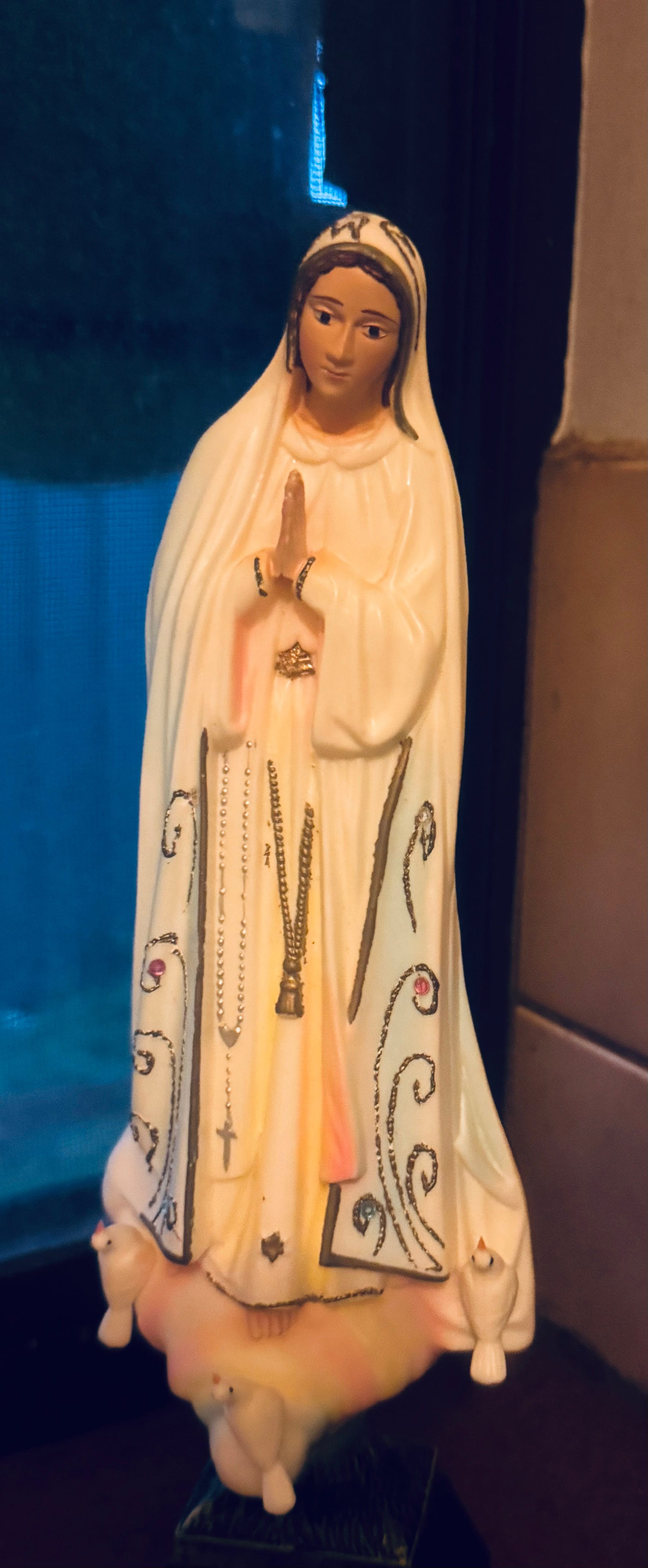
Each morning, I say hello to Our Lady of Fatima.
I also thank my coffee machine.
Mary sits proudly on the kitchen window sill with my electric barista next to her. I have made my own altar in the kitchen. Coffee is my sacrament.
Caffeine makes the miracles happen. They’re the two inanimate objects I speak to the most. Mary stands on a rainbow cloud, with doves beneath her feet.
I wonder if her cloud is as soft as my ugg boots. Her close-lipped smile of serenity never shifts. The earth is at her feet. Mary’s face is so peaceful that I’ve started smiling back.
Pursed lips don’t allow the coffee through.
We hang out to the sounds of hot coffee from freshly ground arabica beans. Her gift is mercy. So, you can see they both have a lot in common. My coffee machine hums loudly. I smile confidently while waiting for the warmth to start the day.
In my family, you receive mercy whether you want it or not.
Mum thinks I’m still fifteen. I’m old enough to appreciate the sentiment. I’ve been unwrapping myself for months now, and I can see the weight of my own skeleton.
Hot drinks all round.
The day can begin.
Mum is waiting for the priest to arrive. The lights are on and she sits up straight in her chair. I’ve cleaned the house, the sink is sparkly, and she has a new bin liner. The important things are done. The television is on volume level 57. I don't bother speaking.
She’s not eating because she is taking communion. I think God wouldn’t mind an elderly diabetic woman having a bit to eat. I’m told a definitive “no” at the offer. Two of the church ladies are also coming around.
There are no prayers for salvation in this home, only endurance. Mum offers hers up to the holy souls in purgatory. She’s proud of it and tells people her secrets to pain management.
Suffering becomes useful in that way; the failures of the self are turned outward into prayers for any who need them.
My Catholic aunt once told me her punishment as a child was kneeling on gravel. She remembers it as both harm and glory. I was eleven at the time. The horror of it still makes me recoil.
Warm coffee, warm heart, warm hands. I cradle my mug and retire back to my room. I sit on the bed and watch the blue sky.
The priest arrives and administers communion for mum. There is prayer. I feel a sense of peace in the house. The rhythmic murmurs sound the same as mum’s television shows from the other room.
For some reason, I remember Father Crawford. He became famous for leaving the church to get married when I was a chlld. Women wept for his soul.
He made me cry for other reasons. He told me I was a sinner before my eleventh birthday. He told me God thought women were lesser than men.
I will never forget that day.
I remember sitting back down afterwards and understanding I was suitable for labour but not for blessing. I remember the feeling of emptiness he left behind. A void of failed hope and confusion.
I was still paying for Eve’s mistakes. Is every daughter responsible for the sins of the mother?
Mum’s visitors don’t see me at church. There is a look of concern for my soul. They pray for me. I smile and thank them. I wish they’d see the flowers that I planted.
I’ve prepared biscuits and slices. The matching cups and saucers are out. The rules of hospitality apply. The prestige is in the effortlessness. I listen to the rhythms of prayer when they are spoken aloud.
“Hail Mary, full of grace, the Lord is with thee.”
My mother sometimes complains when the priest leaves that she never knows what to say to him. He is the priest, after all.
The women gather around mum’s card table on the last Friday of each month. She tells them about the miracles she receives each day. There is a murmur of recognition. Comparisons of holiness and divine communions ensue. They lean into each other.
I breathe: sacred.
My heart beats: sacred.
Washing up: sacred.
Phone call: sacred.
Survival: sacred.
Stars: sacred.
Coffee: sacred.
When I was a child, mum attended Legion of Mary meetings. Irish women who moved to Australia in the 1980s. They wore blouses with miraculous medals around their necks.
The Legion was remarkably progressive for its time. Founded in Dublin in 1921, they were ordinary church going folk who became a global movement. Volunteers visited those on the edge of life; the prostitutes, the poor, the dying and the forgotten. Mercy, rather than condemnation is a beautiful gift to bring to a neighbour.
This wasn’t Dublin though. Where I grew up, they did a lot of praying for people in bad marriages. Neediness was more subtle in suburbia. I watched women work while men sat. I saw bruised backs and black eyes. It appears that the other sons of God needed to step up.
The church women suggest I watch services online. I decline as gently as I can. I make sandwiches. I make drinks. I bake. The women from church appreciate the effort. Jelly slice remains the marker of a successful homemaker.
The biscuits remain untouched. The mug is still half full. I cannot turn water into wine, but I can do the dishes. I cook twenty-eight meals a week. I wish there were more mercy in the visiting, more nourishment and less explanation.
The lawnmower man arrives like the priest. He is offered tea. My mother has begun referring to some visitors as “the help” in her decline. It is the only thing that makes me flinch.
Everyone leaves with something sweet; chocolate honeycomb, biscuits, a small kindness. Even the postman comes to the door expecting his portion.
Mum always said to ask Mary, rather than Jesus. If Mary tells Jesus to do something, he has to. Even the Son of God seeks benediction from the mother in my house.
I spent many years running from this place and trying to prove something to myself. Status is meaningless when a heart lays tarnished on a shelf. My shelf only has space for my coffee machine.
A few nights ago, I dreamed of a woman sitting at the end of my bed. I was crying, telling her everything. She patted my leg and said she would lodge a formal complaint. I have felt strangely better ever since.
That’s why it’s important to have a bit of faith. I’ll put the kettle on and make you a cuppa instead.
And that is called wisdom ☕️ Thank you for reading.
The phrase 'In my family, you receive mercy whether you want it or not' truly caught my attention. Providing care for a parent who still perceives you as fifteen—while you clean the sink, bake jelly slices, and support their faith—requires a particular kind of quiet resilience. I appreciate you articulating the sacredness involved in just showing up.